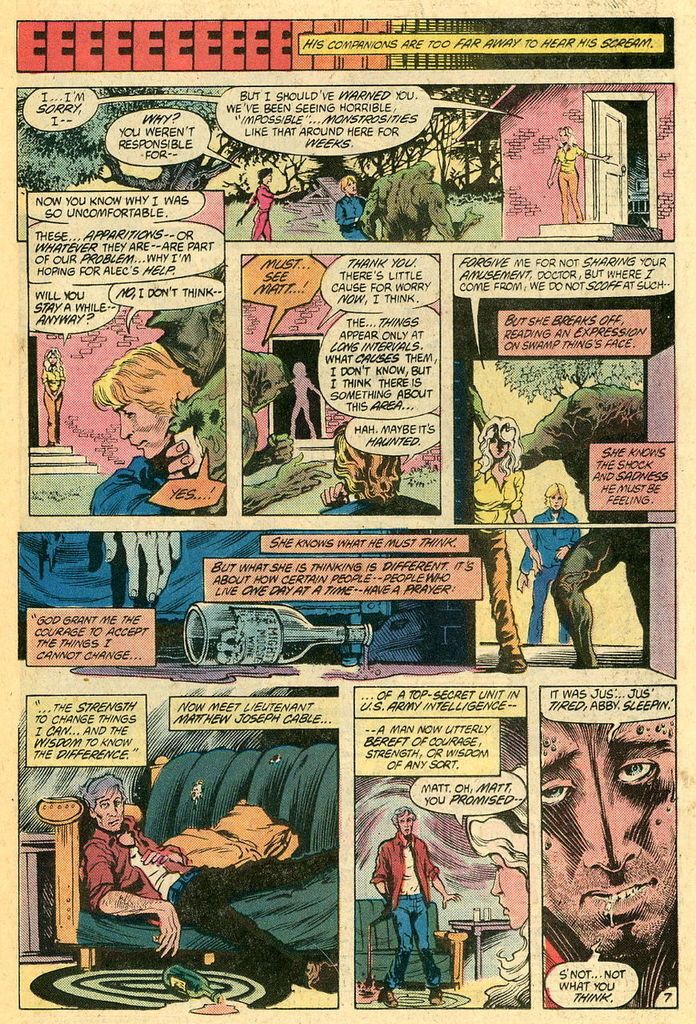
From Swamp Thing no. 17, Oct. 1983, written by Marty Pasko, art by Steve Bissette and John Totleben.
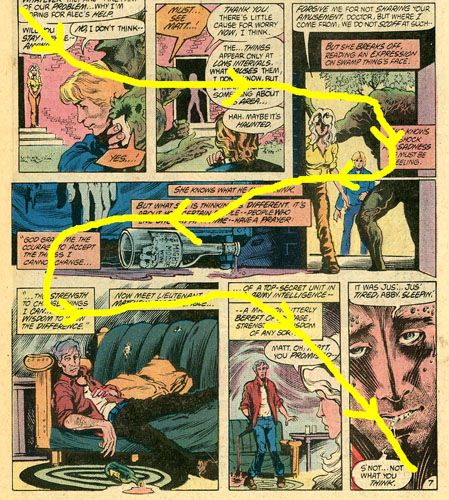
Derik Badman has identified this construction in the comics of Joseph Lambert (see http://madinkbeard.com/blog/archives/right-to-left)--specifically, the use of a reverse-L shaped panel to start the reading of a tier from the "wrong side" and lead to reading the entire tier right-to-left. In the comments to his post, I mentioned that I had noticed this before and that I could think of two examples from (as I could recall) "Swamp Thing" and "Man-Thing." I haven't found the latter, but here is the former. As you'll notice, when Abby and Alec (i.e. the Swamp Thing) enter the house, the panel is formatted as the top panel in a "reverse-L" shaped two-panel tilt-down sequence.* We are thus led to start reading the tier-long panel from the right to the left--which has the effect of a leftward pan. The captions too participate in this effect, as they read right to left rather than the opposite (and more usual) way--and this helps us feel that we are following Abby's, and more importantly Alec's, gazes as they discover Alec's old friend Matt Cable. Cable's alcoholism is here revealed to Alec and to the reader for the first time, synecdochically: at first we are only shown his hand and the bottle. The suspense constructed by the synecdoche is then resolved in the next panel down, when we are shown Matt in his entirety.
This sequence is also interesting as it creates, visually and without the need for instructions, a Brian Chippendale-like reverse-S path of reading across the last three tiers. Our eye is led along this path through each panel's incompleteness being resolved in the next panel, and so on--the drive toward the solution of each momentary mystery (what do Abby and Alec see? Whose is that hand?) here overriding well-established conventions of reading direction. I'll have a lot more to say about this drive to resolve incompleteness (which I see as one of the motors of comics) in the next weeks.
----------------------------
* From the list of terms I distribute to my comics class:
"--Pan Sequence (Panoramic Breakdown): sequence of panels that divides an otherwise unified diegetic space, which continues from panel to panel and can be seen "behind" the gutters, as it were; usually occupies one tier of panels
--Following Pan: pan sequence in which the same character recurs in every panel
--Tilt Sequence, Following Tilt: like Pan Sequence, Following Pan, but vertical rather than horizontal"